
You’ve seen the ads. Bright, glossy hoardings along the Dwarka Expressway and Sohna Elevated Road. Facebook campaigns promising “Apni Zameen, Apna Aasmaan” (Your Land, Your Sky). And the buzz in investor circles is impossible to ignore.
The Deen Dayal Jan Awas Yojana Gurgaon (DDJAY) policy has, in the last few years, shifted from a sleepy government scheme to the single most disruptive force in the NCR real estate market. It’s the dream of every middle-class Indian: a plot of land in a gated society within the Millennium City, where you can build your own home. Not a cramped apartment in a 30-storey tower, but an independent floor with your own terrace and stilt parking.
It sounds perfect. Almost… too perfect.
For many seasoned investors and first-time buyers, the question lingers: Is DDJAY plots in Gurgaon a genuine goldmine, or is it a cleverly disguised landmine, riddled with hidden costs, location compromises, and infrastructure delays?
As a leading real estate consultant in Gurgaon, we at AAR Buildtech believe in radical transparency. Let’s be blunt: investing in deen dayal awas yojna plots is not a simple “buy it and forget it” decision. It’s a high-stakes, high-reward opportunity, and recent policy changes in 2025 have completely rewritten the rules.
This is your ultimate guide to navigating the deen dayal jan awas yojana gurgaon maze as of November 2025. We will look at whether these deen dayal affordable plots truly live up to the hype.
Understanding the Policy: What Exactly is Deen Dayal Jan Awas Yojana (DDJAY)?
Launched by the Haryana government in 2016, the Deen Dayal Jan Awas Yojana (DDJAY) policy had a simple, noble goal: to curb the rampant spread of unauthorized, illegal colonies and provide affordable plotted housing. The government essentially made a deal with private developers. “You can carve out plots in high-potential areas,” they said, “but there are rules.”
The Original Promise: More Than Just Affordable Plots
The initial policy was highly attractive for several reasons:
- Affordable Plot Sizes: Developers could create high-density plotted colonies with plot sizes capped at 150 sq. meters (approx. 179 sq. yards). This ensured that the DDJAY plots remained accessible to the middle-income segment.
- Gated Infrastructure: Unlike illegal colonies, the developer was responsible for providing superior internal infrastructure: paved roads, streetlights, water supply, sewage systems, and landscaped parks. This structured environment is key to the value of deen dayal awas yojna plots.
- Location: The policy targeted “low and medium potential” zones, which in Gurgaon’s context meant the emerging corridors of Sohna, Farukhnagar, Pataudi, and the newer sectors of New Gurgaon. These are the areas set to benefit from major infrastructure boosts like the Delhi-Mumbai Expressway.
- FAR Control: The policy initially allowed for a Floor Area Ratio (FAR) of 2.0, with construction limited to Stilt + 3 floors.
For years, it was a good, steady option. But in 2024 and 2025, a series of amendments from the Haryana Town and Country Planning (DTCP) department poured rocket fuel on this fire.
The “Too Good” Part: Why DDJAY is Gurgaon’s Hottest Ticket in 2025
If you’re wondering why Deen Dayal Jan Awas Yojana Gurgaon is suddenly all anyone can talk about, it’s because the government updates have turned it from a simple plotted scheme into a powerful wealth-generation tool for investors and a dream fulfilled for end-users.
The 2025 Policy Game-Changer: Stilt + 4 Floors (S+4)
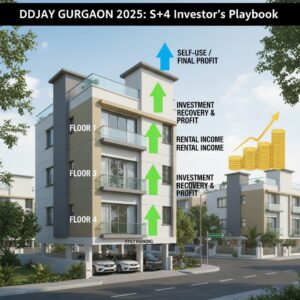
This is the single biggest update. The Haryana government, in a move to increase housing supply, has now permitted the construction of Stilt + 4 Floors (S+4) on DDJAY plots.
Why is this a big deal for deen dayal plots gurgaon?
- For End-Users: You can now get a brand-new, independent builder floor in a gated society for the price of (or even less than) an old apartment in a crowded high-rise. This makes deen dayal jan awas yojana gurgaon a game-changer for independent living.
- For Investors: The math is intoxicating. An investor can buy a 120 sq. yard plot, build a high-quality S+4 structure, and then sell three of the independent floors. They can often recover their entire principal investment (plot + construction) and still be left with one floor, free of cost, as pure profit.
- Floor-Wise Registry: Crucially, the policy allows for the separate registry of each floor. This makes it easy to sell individual units, secure bank loans for each floor, and gives clear title to four different owners.
Goodbye, Red Tape: The 50% Saleable Area Freeze is Gone
Another massive 2025 update was the removal of the 50% “freeze” on saleable area. Previously, a developer had to complete all internal development work before selling the entire inventory. Now, that restriction is gone.
This means:
- Faster project execution and better cash flow for reputable builders (like Signature Global, ROF, JMS).
- More inventory of DDJAY plots in Gurgaon available for immediate buyers.
The End of “Apartment Fatigue”: Your Own Land, Your Own Roof
The post-pandemic world has triggered a fundamental shift in buyer preferences, moving away from high-density towers. Deen dayal awas yojna plots are the perfect antidote, offering the “Big 3” of Indian real estate dreams:
- Independence: Your own building, your own rules.
- Space: A full floor, often with a private terrace or basement.
- Legacy: You own a piece of land—an asset you can pass down through generations.
Financial Flexibility: Bank Loans are Finally Easy
In the early days of DDJAY, getting a bank loan was complex. Today, the market has matured. With RERA-approved projects from Grade-A builders and the S+4 policy clarifying individual floor ownership, virtually every major bank (HDFC, ICICI, SBI) and NBFC is aggressively funding deen dayal affordable plots. You can secure plot loans, construction loans, and home loans for individual builder floors.
The “True” Part: The Hidden Risks and Realities You Must Know
This is the part most sellers won’t tell you. At AAR Buildtech, our job is to protect your investment. The Deen Dayal Jan Awas Yojana is not without serious risks. If it sounds “too good to be true,” it’s because the “true” part is complicated.
Risk 1: “Location, Location, Location”… But Which One?
Let’s be very clear: DDJAY plots in Gurgaon are not typically on Golf Course Road or MG Road. The policy was designed for emerging areas. You are trading a prime, established location for affordability and independence.
The risk? You are betting on future infrastructure.
- The Promise: The developer’s brochure shows a 60-meter road, a future metro stop, and a new commercial hub.
- The Reality: That 60-meter road might be a 20-foot dirt track today. The metro plan might be 10 years away from sanction.
This is where your diligence matters. A plot in DDJAY Sohna, which is now fantastically connected by the Sohna Elevated Road and Delhi-Mumbai Expressway, is a world apart from a plot in a remote sector of Pataudi where connectivity is still a decade away.
Risk 2: The Price Tag vs. The Final Cost: Decoding the DDJAY Math
This is the most common trap when buying deen dayal plots gurgaon. A broker quotes you a Base Sale Price (BSP) of ₹1,20,000 per square yard. You think, “Great, a 100 sq. yard plot will cost me ₹1.2 Crore!”
You are wrong.
The BSP is just the beginning. Your final Landed Cost will include a laundry list of other mandatory charges:
- External Development Charges (EDC) & Infrastructure Development Charges (IDC): These massive costs are levied by the government (not the builder) for developing the external infrastructure around your project (expressway linkages, master sewer lines, etc.). This can add 10-15% to your BSP.
- Preferential Location Charges (PLC): Want a park-facing plot? A corner plot? Expect to pay a significant premium.
- Club Membership: Often a mandatory, non-negotiable charge.
- GST: Applicable at 5% on under-construction components.
- Stamp Duty & Registry: The standard government charges on the total value.
AAR Buildtech Pro-Tip: A plot advertised at ₹1.2 Cr (BSP) will almost certainly cost you ₹1.40 Cr to ₹1.45 Cr by the time the registry is in your name. Always demand a Final Cost Sheet before paying any booking amount for deen dayal jan awas yojana gurgaon.
Risk 3: The “S+4” Density Dilemma
The Stilt+4 policy is a double-edged sword. While it’s a boon for investors, it creates a serious density problem for end-users.
A 120 sq. yard plot, which was originally meant for one family, will now house four families. A single lane designed for 20 homes will now service 80 families.
This will put an immense strain on:
- Parking: Even with stilt parking, most Indian families own multiple cars, leading to street congestion.
- Services: Will the water pressure be adequate for four independent floors? Will the sewage system handle the increased load effectively?
- Common Areas: The small community park will be shared by four times the original expected population.
It’s no longer “low-density” living. It is “low-rise, high-density” living, a crucial factor for end-users considering deen dayal awas yojna plots.
Risk 4: The Developer Lottery
In DDJAY, you are buying into a promise: roads, parks, a clubhouse, and security. What if the developer fails to deliver? You could be stuck with a plot in a half-finished colony with poor internal roads and delayed services.
This is where builder reputation is non-negotiable. Stick to Grade-A, RERA-compliant developers with a proven track record of delivering on their promises in Gurgaon. Names like Signature Global, ROF Group, JMS, and Vatika have multiple successful Deen Dayal Jan Awas Yojana Haryana projects and a reputation to protect. Avoid new, unknown developers offering “unbelievable” prices.
The Investor vs. The End-User: Who is DDJAY Really For?
Your investment strategy for DDJAY plots should be entirely different based on your primary goal.
The Investor’s Playbook (Post-2025 Policy)
For a pure investor, DDJAY is arguably the best investment in Gurgaon right now. The playbook is simple and effective:
- Identify: Find a 100-150 sq. yard plot in a high-growth corridor (like Sohna or the sectors around Dwarka Expressway).
- Buy: Purchase the plot from a reputed builder.
- Build: Once possession is offered, construct a high-quality S+4 building.
- Monetize: Sell 3 of the floors. The proceeds should, in most cases, cover your entire cost of land + construction.
- Profit: You are now the owner of a brand-new, premium builder floor, essentially free of cost. You can rent it for a high rental yield or sell it after 5 years for massive capital appreciation. This is the financial sweet spot of deen dayal jan awas yojana gurgaon.
The End-User’s Dream (With a Checklist)
For an end-user (a family who wants to live there), the focus is on Quality of Life. Here is your checklist for buying deen dayal plots gurgaon:
- Builder Due Diligence: Is the builder’s RERA registration valid? Visit one of their older projects to see the quality of maintenance and community living.
- Infra Status: Don’t trust the brochure. Visit the site. Are the internal roads built? Are streetlights installed? Has the builder paid their crucial EDC/IDC dues?
- Plot Location: Look around the plot. Is it near a high-tension wire? Choose a quiet, internal road away from major traffic flow.
- Buy vs. Build: Do you have the time and energy to manage construction? Or does it make more sense to buy a ready, completed “builder-floor” from a trusted developer? Both are valid options under deen dayal affordable plots.
Gurgaon’s DDJAY Hotspots: Where is the Real Action in November 2025?
Prices in DDJAY are hyper-local, varying based on connectivity and proximity to infrastructure catalysts like the Airport (IGI), Expressway, and major SEZs.
| Location Belt | Connectivity & Catalysts | Indicative Price Range (per sq. yd) Q4 2025 | Best For |
| Dwarka Expressway Belt (Sec 99-113) | Fully operational Expressway; seamless access to Delhi’s IGI Airport and New Gurgaon business hubs. | ₹1.90 Lac – ₹2.40 Lac | Premium investors and end-users prioritizing Delhi connectivity. |
| New Gurgaon (Sec 81-95) | Well-connected to NH-8 & SPR; mature social infrastructure (schools/hospitals). | ₹1.10 Lac – ₹2.0 Lac | End-users seeking a “ready” ecosystem and stable appreciation from deen dayal jan awas yojana haryana. |
| Sohna (South of Gurgaon) | Direct access via Sohna Elevated Road; proximity to Delhi-Mumbai Expressway and industrial growth corridors. | ₹70,000 – ₹1.25 Lac | First-time buyers and long-term investors (5-7 year horizon) seeking maximum appreciation potential. |
| The Next Frontier (Manesar, Farukhnagar) | Long-term growth driven by industrial expansion (Reliance MET) and future connectivity projects. | ₹60,000 – ₹85,000 | Purely long-term (10+ year) land-banking investors. |
Suggested Read; Gated Community vs Independent House: A Gurgaon Homebuyer’s Ultimate Guide
The Final Verdict: Is DDJAY “Too Good to be True?”
No. The Deen Dayal Jan Awas Yojana is not too good to be true.
It is, however, too complex to navigate alone.
It is a phenomenal government policy that has successfully created a new, organized real estate segment sitting perfectly between cramped apartments and wildly expensive private bungalows. The 2025 policy amendments (like S+4) have unlocked its potential for investors, making it a powerful tool for wealth creation. For end-users, it remains the only way to realize the dream of an independent home in a secure, gated Gurgaon address.
The “catch” isn’t in the policy itself. The catch is in the execution. The risk lies in picking the wrong location, underestimating the costs (EDC/IDC), or trusting the wrong developer with your investment in deen dayal awas yojna plots.
Don’t let a slick brochure or a “limited-time offer” rush you. Your investment is worth millions. It deserves expert, unbiased guidance.
How AAR Buildtech Can Help You Navigate the DDJAY Maze
At AAR Buildtech, we are not just brokers; we are your dedicated real estate consultants. We don’t just “sell” you a plot; we help you build a strategy for your deen dayal plots gurgaon investment.
- We Decode the Costs: We’ll give you the final landed price, inclusive of all hidden charges (EDC, IDC, PLC, etc.). No surprises.
- We Vet the Developer: We only work with Grade-A builders after checking their RERA status and delivery record.
- We Identify the Right Location: Based on your goal (investment or end-use), we’ll help you choose the right sector—one with real infrastructure, not just brochure promises.
- We Guide You End-to-End: From site visit to booking, loan assistance, and right through to your registry, we are with you at every step.
The DDJAY market is complex, but it doesn’t have to be confusing. Don’t just buy a plot. Buy the right plot.
Talk to our DDJAY specialists today for a free, no-obligation consultation.
Call AAR Buildtech: 88009-88803
Frequently Asked Questions (FAQs) about DDJAY Gurgaon
The policy allows for DDJAY plots up to 150 square meters (approximately 179.4 sq. yards). You will commonly find sizes ranging from 80 sq. yards to 179 sq. yards, providing options for both smaller and slightly larger independent homes.
Yes, the S+4 construction allowance is a state-wide Haryana policy amendment (as of 2025). All DDJAY plots, including those in older, already-delivered projects, are now eligible for S+4 construction, subject to filing for plan approval with the concerned local authorities.
No. EDC (External Development Charges) and IDC (Infrastructure Development Charges) are set by the government and vary significantly based on the “zone” of your project. A project in a high-potential zone (like the Dwarka Expressway) will have much higher EDC/IDC than one in Sohna or Pataudi. Always ask for the official government notification of these charges to determine the true cost of your deen dayal affordable plots.
Yes, Non-Resident Indians (NRIs) are permitted to purchase immovable property in India, including residential plots under the Deen Dayal Jan Awas Yojana scheme, subject to FEMA (Foreign Exchange Management Act) guidelines. It’s a popular avenue for NRIs seeking to acquire land in the NCR.
As per the Deen Dayal Jan Awas Yojana Haryana policy, the internal roads in a DDJAY colony must be at least 9 meters (approx. 30 feet) wide, with some main roads being 12 meters or more. This ensures better traffic flow and planned infrastructure within the gated community.
No, they are different. HSVP (Haryana Shehari Vikas Pradhikaran) plots are developed and sold directly by the government via an auction/draw system. DDJAY plots are developed and sold by private developers (like Signature, ROF, etc.) under a specific government policy framework. DDJAY projects are typically in gated societies with private amenities, which is the key distinction.
You can start construction on your deen dayal plots gurgaon once the developer has received the Completion Certificate (CC) for the infrastructure of the entire DDJAY colony and you have received possession of your individual plot. You will then need to get the building plan for your S+4 structure approved by the DTCP.